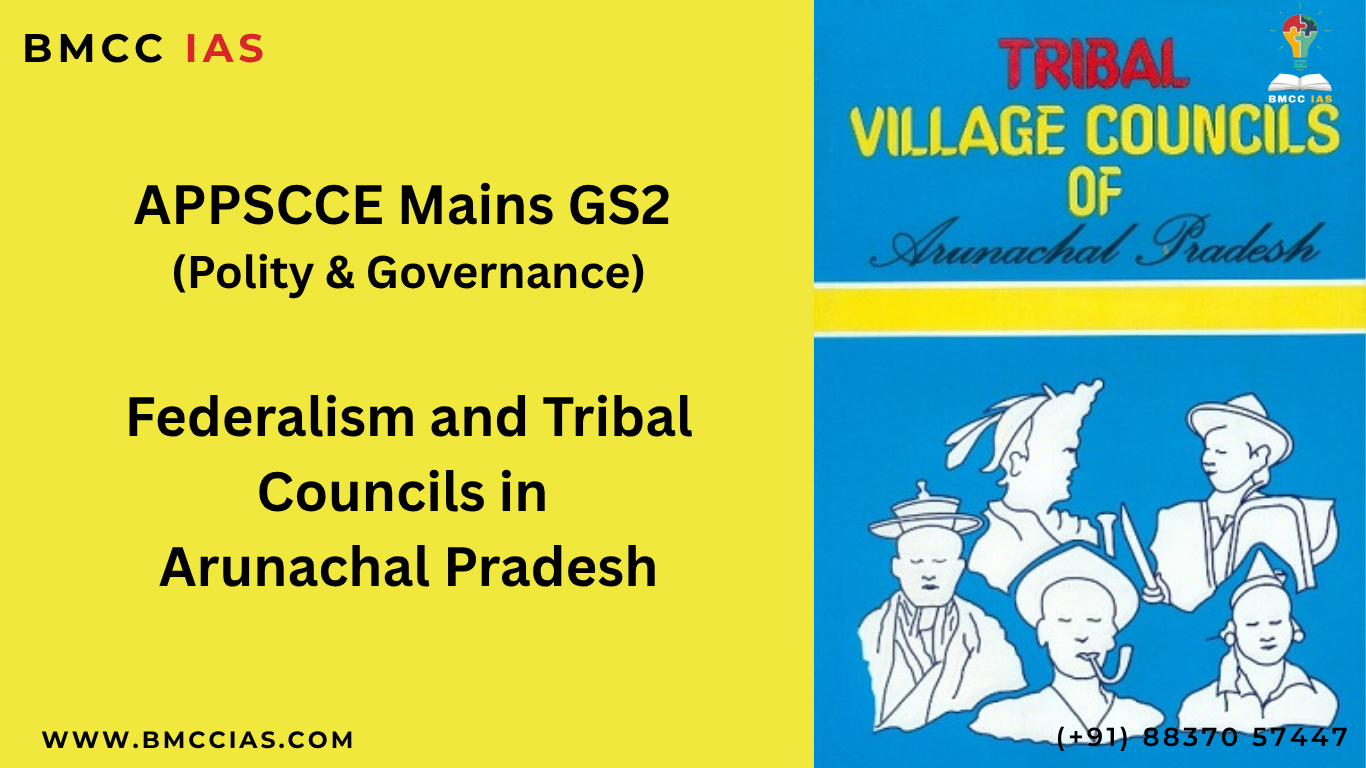
Mains GS2 (Polity & Governance): Federalism and Tribal Councils in Arunachal Pradesh
BMCC IAS – BEST IAS INSTITUTE IN ITANAGAR & NAHARLAGUN
Federalism in the Indian Constitution – A Quick Overview
India is a federal polity with unitary bias, where powers are divided between the Union and the States through Union, State and Concurrent Lists. For APPSCCE and UPSC Mains GS2, federalism is a core theme linked with:
- Centre–State relations.
- Local self‑governance.
- Special provisions for North‑East and tribal areas.
Federalism and the North‑East: Special Context
The North‑Eastern region, including Arunachal Pradesh, has:
- Ethnic diversity.
- Tribal populations with strong customary practices.
- Strategic international borders.
The Constitution provides special protections and institutional mechanisms to balance national integration with local autonomy – a key area you must highlight in GS2 answers.
Tribal Councils and Customary Institutions
In Arunachal Pradesh, along with formal institutions like the State Government and Panchayats, traditional tribal councils (locally known by different names among tribes) play an important role in:
- Dispute resolution.
- Social regulation.
- Management of community resources.
- Preservation of customs and customary laws.
In a GS2 Mains answer, you can frame them as “community‑based governance institutions”that complement constitutional structures.
Federalism, Sixth Schedule and Arunachal Pradesh
While some North‑Eastern states enjoy Sixth Schedule Autonomous District Councils, Arunachal Pradesh’s tribal governance system relies heavily on:
- Customary laws.
- Village‑level and clan‑level councils.
- Evolving engagement between these institutions and formal democratic bodies.
In an APPSCCE Mains answer:
- Acknowledge that Arunachal’s tribal councils are not Sixth Schedule ADCs.
- Emphasise their functional similarity in terms of local self‑governance and cultural preservation.
Challenges in Centre–State–Tribal Institution Relations
Key issues you can discuss in GS2 answers:
- Jurisdictional overlap: Confusion between formal courts and customary councils in civil and criminal matters.
- Codification of customary law: Tension between flexibility of tradition and need for legal clarity and human rights compliance.
- Resource control: Forests, land and water often lie at the intersection of community control, state ownership and national‑level conservation policies.
- Development vs culture: Infrastructure projects, dams, mining and roads may clash with the rights of indigenous communities.
Case Study Framework for APPSCCE Mains
While writing GS2 answers on federalism and tribal councils, use a simple case study template:
- Background: Briefly describe the tribe/region and the customary institution.
- Issue: Land dispute, forest rights, hydropower project, border village connectivity, etc.
- Stakeholders: Local community, State Government, Union Government, security agencies, NGOs.
- Conflict of laws: Customary law vs statutory law or central legislation.
- Resolution model: Dialogue, legal reform, participatory governance, social audit, Gram Sabha‑like consultations.
- Way forward: Harmonising customary rights with constitutional values and sustainable development.
How to Link Federalism, Tribal Councils and Governance Reforms
In GS2, always connect theory with reform:
- Advocate decentralised planning, where tribal councils are consulted in district plans.
- Suggest capacity‑building programmes for council members on constitutional rights, gender justice and environmental laws.
- Recommend documentation and partial codification of customary practices to protect them from misuse and misinterpretation.
- Emphasise cooperative federalism, where Centre and State support community institutions rather than bypassing them.
Answer‑Writing Tips for GS2 Federalism Questions
When BMCC IAS faculty gives a question like:
“Discuss the role of tribal councils in strengthening federalism and local self‑governance in Arunachal Pradesh.”
You can structure your answer as:
- Introduction: Define federalism and briefly mention tribal councils as informal local governance structures.
- Body:
- Constitutional framework of federalism.
- Role and functions of tribal councils with examples.
- Synergies and conflicts between State institutions and tribal bodies.
- Way forward: Reforms, dialogue mechanisms, integration with formal Panchayati Raj without eroding autonomy.
- Conclusion: Emphasise that true federalism respects diversity while upholding constitutional values.
BMCC IAS Support for GS2 Federalism & Tribal Topics
At BMCC IAS – Best IAS Institute in Itanagar – GS2 classes:
- Provide Arunachal‑specific examples and case studies.
- Help you frame answers that go beyond generic Polity theory.
- Train you to integrate tribal councils, customary law and local governance into federalism answers.
This combination is exactly what APPSCCE and UPSC evaluators look for in high‑scoring GS2 scripts.
Tag:APPSCCE 2025 GS2, APPSCCE coaching in Itanagar, APPSCCE GS2 polity, APPSCCE mains governance, APPSCCE mains preparation polity, Best IAS Institute in Arunachal Pradesh, Best IAS Institute in Itanagar, Best Institute for APPSC, BMCC IAS, BMCC IAS GS2 coaching, BMCC IAS polity classes, Centre State relations North East, civil services coaching Naharlagun, community based governance, constitutional provisions for tribes, cooperative federalism examples, customary law Arunachal, federalism and diversity, Geography optional Arunachal, governance reforms tribal regions, GS2 answer writing Arunachal, GS2 case studies Arunachal, GS2 federalism notes, GS2 tribal issues framework, IAS coaching in Itanagar, IAS coaching in Itanagar GS2, local self governance tribal areas, North East federalism, PSIR coaching Itanagar, tribal councils and Panchayats, tribal councils Arunachal Pradesh, tribal governance India, UPSC coaching in Arunachal Pradesh, UPSC GS2 federalism
You may also like
Fundamental Duties