
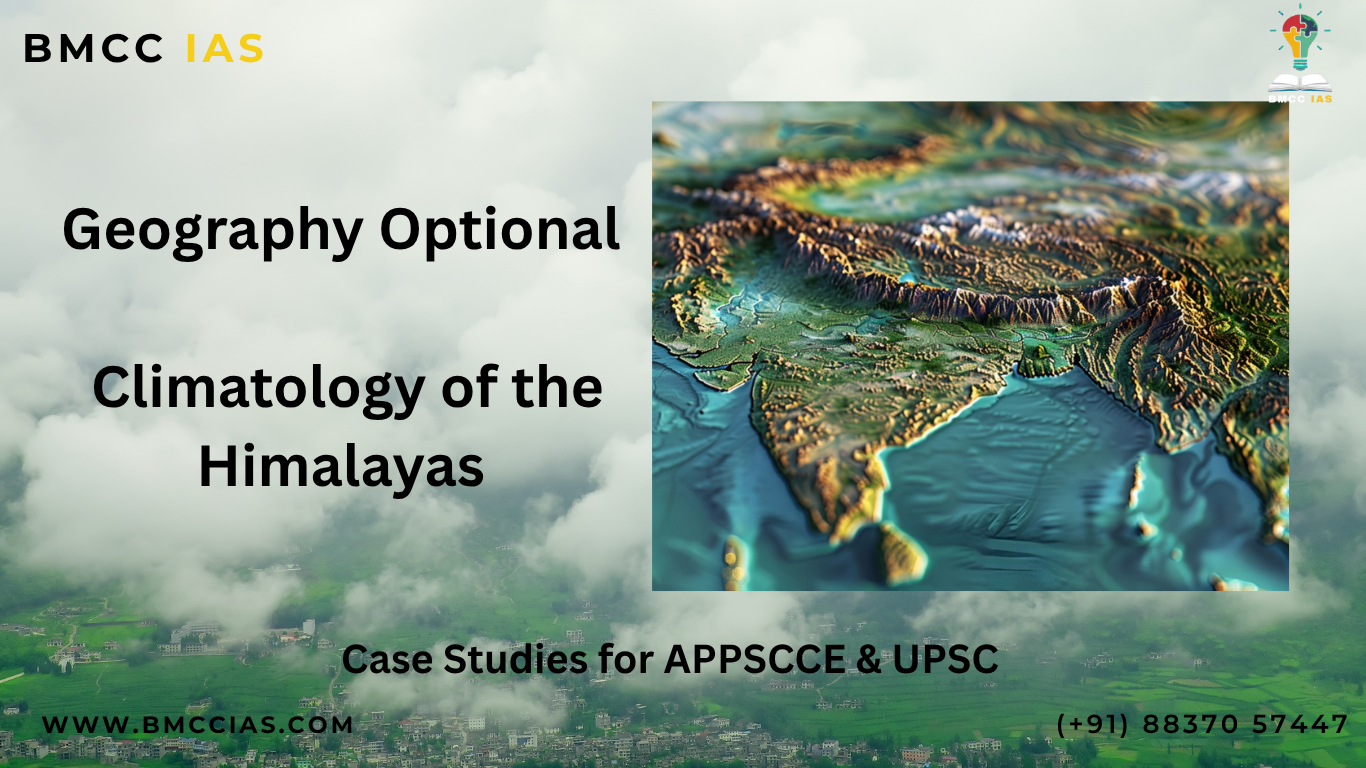
Geography Optional – Climatology of the Himalayas
Case Studies for APPSCCE & UPSC
Why Himalayan Climatology Matters in Geography Optional
BMCC IAS – BEST IAS INSTITUTE IN ITANAGAR & NAHARLAGUN
For Geography optional aspirants at BMCC IAS, the Himalayan climatology topic is a scoring area that can be used in:
- Climatology questions.
- Indian Geography.
- Environment and Disaster Management.
- Map‑based answers and case studies.
For APPSCCE and UPSC, using specific Himalayan examples in your answers sets you apart from generic candidates.
Key Features of Himalayan Climate
When writing notes or answers:
- Mention altitudinal variation – climate changes rapidly with height.
- Highlight orographic rainfall – monsoon winds rise over the Himalayas and cause heavy precipitation on the southern slopes.
- Note rain‑shadow effects on leeward sides like Ladakh.
- Discuss seasonal snowfall, glacial accumulation and melting patterns.
Monsoon–Himalaya Interaction
The Himalayas act as:
- A barrier to south‑west monsoon winds, causing intense rainfall on the foothills.
- A climatic divide between the Indian subcontinent and Central Asia.
- A regulator of timing and intensity of monsoon rainfall across North India and the North‑East.
In answers, link this to agriculture, river regimes and flood patterns in the Indo‑Gangetic plains and Brahmaputra basin.
Case Study 1: Cloudbursts and Flash Floods in Uttarakhand
Use Uttarakhand as a case study:
- Steep slopes, intense rainfall and fragile geology make the region prone to cloudbursts and flash floods.
- Deforestation, unplanned construction and road‑widening projects increase vulnerability.
- Kedarnath 2013 floods are a classic example of climate + human interference interaction.
In a Geography optional answer:
- Draw a simple sketch map.
- Show wind direction, orographic lift and zones of heavy rainfall.
- Mention disaster‑management lessons for other Himalayan states, including Arunachal Pradesh.
Case Study 2: Glacial Lake Outburst Floods (GLOFs) in Eastern Himalayas
Eastern Himalayas, including parts of Arunachal Pradesh and neighbouring regions, face:
- Glacial retreat due to rising temperatures.
- Formation of unstable glacial lakes behind weak moraines.
- Risk of GLOFs, which can cause sudden destructive floods downstream.
Use this case to answer questions on:
- Climate change impacts on Himalayas.
- Transboundary water issues.
- Disaster‑risk reduction strategies.
Case Study 3: Changing Snowfall Patterns and River Regimes
Many Himalayan rivers are snow‑ and glacier‑fed. With changing climate:
- Snowfall timing and volume are shifting.
- Glacial melt regimes are altering river discharge patterns.
- This affects hydropower, irrigation, drinking water and ecology.
Use examples of:
- Early snowmelt causing higher spring flows and lower late‑summer flows.
- Increased sediment load affecting dams and reservoirs.
Linking Himalayan Climatology to North‑East and Arunachal Pradesh
As an APPSCCE aspirant, always bring the answer closer to home:
- Arunachal Pradesh receives high rainfall due to its location in the Eastern Himalayas and orographic effects.
- The region faces landslides, floods and erosion linked to intense rainfall and fragile mountain slopes.
- Climate variability affects traditional agriculture, shifting cultivation patterns and forest health.
Using state‑specific references will impress APPSCCE evaluators.
How to Use These Case Studies in Answers
In Geography optional and GS answers:
- Start with a conceptual explanation (e.g., orographic rainfall, climate change, monsoon dynamics).
- Insert one or two Himalayan case studies with names, years (approximate), and impacts.
- Conclude with adaptation and mitigation strategies – afforestation, early‑warning systems, land‑use planning, community awareness.
BMCC IAS Support for Geography Optional
BMCC IAS – Best IAS Institute in Itanagar – supports Geography optional aspirants with:
- Topic‑wise classes on climatology and Indian Geography.
- Region‑specific examples and diagrams.
- Answer‑writing sessions using Himalayan and Arunachal case studies.
If you integrate strong conceptual clarity with vivid, real‑world Himalayan examples, your Geography optional marks can significantly improve.

You may also like

Hello APPSC Aspirants!

APPSC – Geography Optional PYQ – 2017-18 – Paper 2