
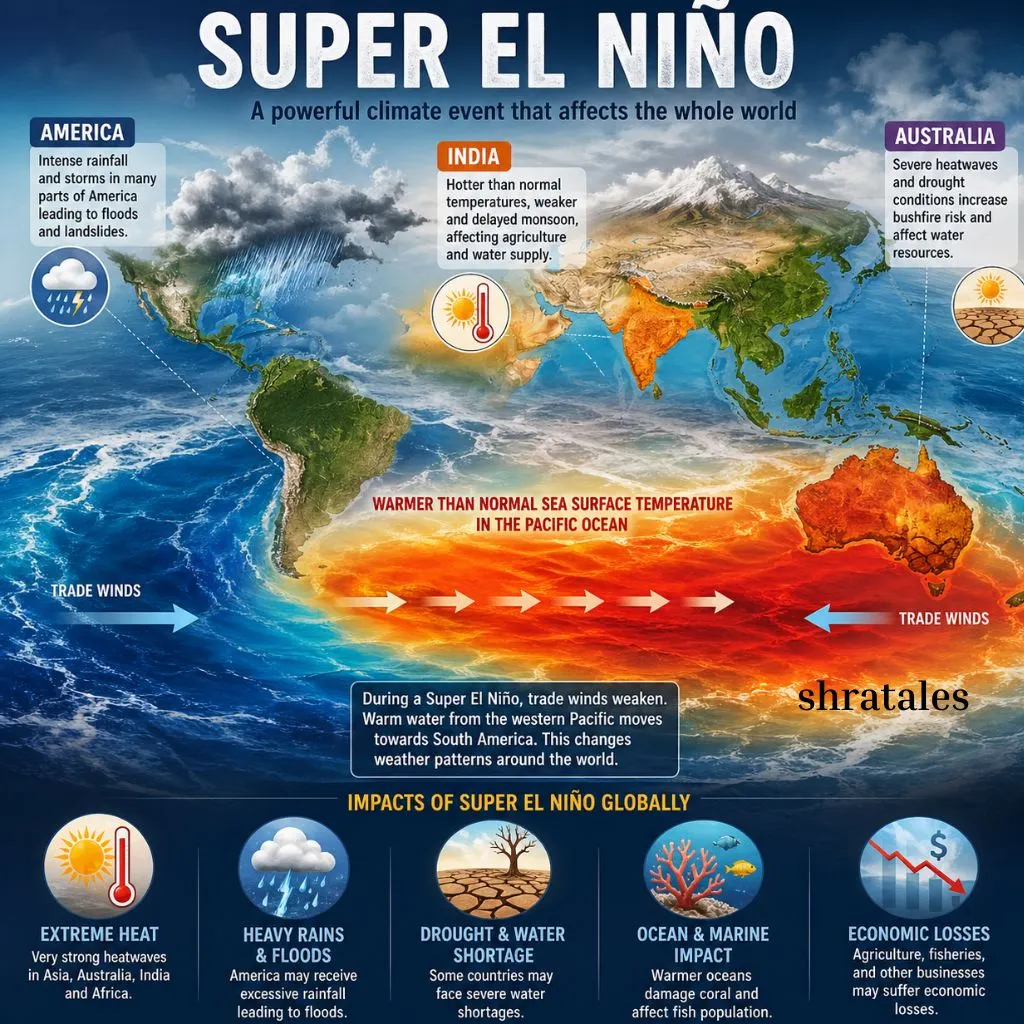
WILL INDIAN MONSOON 2026 BE WEAKER DUE TO EL NINO?
1. Context
1.1 What caused Extreme Heatwave in India?
A “super” El Niño is predicted to occurs in 2026-27, intensifying fears of a weak monsoon and drought in India.
The evidence is seen by extreme heatwaves across the country, such as temperatures reaching 47.4°C in Banda, Uttar Pradesh, and heatwave alerts issued by the India Meteorological Department (IMD) in several states.
2. Lets Understand El Niño in Short?
2.1 Definition and scope
El Niño is a recurring warming of sea‑surface temperatures in the central and eastern tropical Pacific Ocean, forming part of the El Niño–Southern Oscillation (ENSO) cycle. Unlike isolated heat spikes, El Niño disrupts the Pacific’s typical east‑west temperature gradient, where warm water accumulates in the west near Indonesia and cool upwelling dominates the east off Peru. During El Niño, this warm pool shifts eastward, altering atmospheric pressure and wind patterns globally.
El Niño events are gauged by temperature anomalies above the long‑term average: 0.5°C marks a weak episode, 1°C moderate, 1.5°C strong, and 2°C or higher very strong.
3. How is El Niño Formed?
3.1 Mechanisms triggering El Niño
El Niño’s formation begins with a weakening of easterly trade winds over the equatorial Pacific, often instigated by atmospheric pressure shifts or oceanic waves. Normally, these winds push warm surface water westward, sustaining upwelling of cool, nutrient‑rich water along the Peruvian coast and a steep thermocline (warm‑cool boundary) across the basin. When winds become weak, stored warm water flows eastward, deepening the thermocline in the eastern Pacific and shallowing it in the west, disrupting this equilibrium.
3.2 Does Every El Niño Causes Draught in India?
However, climatological evidence underscores that El Niño’s impact on the Indian monsoon is not uniform. The Ministry of Earth Sciences reports 16 El Niño years since 1950, with only 7 experiencing below‑normal monsoon rainfall in India, highlighting the probabilistic nature of the relationship. Even among formidable events like 1982, 1997, and 2015, 1997—a candidate for “super” status—saw near‑normal rainfall due to a compensating positive Indian Ocean Dipole (IOD).
4. What are the consequences and impacts of El Niño
4.1 Global-scale impacts
Globally, El Niño spurs droughts in Southeast Asia, Australia, and eastern Africa due to suppressed rainfall, while triggering floods in South America and parts of the southern United States from enhanced convection. Marine ecosystems suffer as warm water displaces nutrient‑rich cold upwelling, collapsing fisheries off the Americas and coastal communities dependent on them. Atlantic hurricane activity often declines, but cyclone risk spikes in the central Pacific, and temperature extremes amplify worldwide.
4.2 Regional consequences for India
For India, El Niño often elevates the risk of a weaker southwest monsoon, with reduced rainfall in the core zone—central India—though outcomes vary by event. Studies link El Niño years to lower yields for rice and other water‑sensitive crops due to soil moisture deficits and river inflow drops, but irrigation and regional factors moderate losses. Historical variability, as in 1997’s near‑normal rainfall despite intensity, underscores that impacts are context‑dependent and non‑guaranteed.
4.3 Key climate drivers interacting with El Niño
India’s monsoon responds to a suite of interacting factors:
- the Indian Ocean Dipole (IOD), which can enhance or suppress rainfall;
- the Somali Jet, channeling moisture from the Arabian Sea;
- the Madden‑Julian Oscillation (MJO), steering active/break spells;
- the monsoon trough and Bay of Bengal low‑pressure systems, dictating spatial distribution.
5.1 Regional implications for Arunachal Pradesh
In Arunachal Pradesh and the Northeast, a below‑normal monsoon threatens Brahmaputra‑Barak river inflows and irrigation for hydropower‑reliant states, while delayed yet intense spells heighten landslide and flash flood risks on steep slopes. Conversely, above‑normal rainfall during El Niño‑linked events could strain fragile ecosystems .
6. Way Forward
6.1 Enhancing climate forecasting and preparedness
Scientific researches can guide farmers in adjusting sowing calendars, adopting drought‑resistant crops (e.g., short‑duration rice), and governments in reservoir management for lean months.
6.2 Policy and community‑based approaches
Long‑term solutions include climate‑smart agriculture with efficient irrigation, rainwater harvesting to recharge aquifers, and afforestation in catchment areas to stabilize slopes and flows.

You may also like

Fundamental Duties